vado / docs
GitHub

Start here

One Valkey server, made of Durable Objects.

vado runs real Valkey 9.1, compiled to WebAssembly, in Cloudflare Durable Objects. A router in a Worker spreads keys over the shards, so valkey-cli and ioredis see one ordinary server.

Each shard is a Durable Object running the Valkey server itself, with its append-only file (AOF) in the object's SQLite. Clients see one server. The router hashes each key to a slot, sends the command to the shard that owns it, and can read from replicas in other regions.

One database, end to endClick a box to read about itSwipe to explore
How a client reaches a vado databaseClients connect over TCP, a WebSocket or a service binding to a router in the Worker. The router reads the catalog, sends commands to shard Durable Objects running Valkey with its AOF in SQLite, and reads from replicas in other regions. Rewriters compact each shard's AOF. A Watcher polls shards and replicas for the dashboard.valkey-cli, ioredisTCP via Spectrumvado-shimWebSocket /wsYour Workerservice bindingRouterone per connectionCatalogdatabases, placementShardsValkey wasm + AOFRewritersAOF compactionRead replicasother regionsWatcherdashboard, /live
A client arrives over TCP through Spectrum, over the /ws WebSocket through vado-shim, or from another Worker through a service binding. Each connection gets its own router. AUTH names the database, and the router reads its shard count and placement from the catalog once, then keeps it.
Selected pathOther callsResponsibilities, not machines

What you get

  • Valkey's own behaviour. Commands, replies and errors come from Valkey's code, not a reimplementation. Clients connect over TCP, a WebSocket or a service binding.
  • Durable writes. A reply leaves only after its AOF entry is committed to SQLite.
  • Placement you choose. Shards in the regions you pick, and read replicas in others if you want them. A connection always reads its own writes, and WAIT counts the replicas that have them.
  • Deploys that fail no commands. Busy shards restart onto new code after answering what they have read.
  • A password per database, and databases that can be dropped for good.
  • A live dashboard at the Worker's URL: shards, replicas on a globe, where traffic enters, response times and a timeline.

A first command

The AUTH username picks the database, and a new one is created on first use. From a laptop, the WebSocket shim gives any client a local TCP port:

Terminal
npx vado-shim wss://<your-worker>.workers.dev/ws 6379
valkey-cli -p 6379 --user mydb --pass "$VALKEY_PASSWORD"
127.0.0.1:6379> SET greeting hello
OK

Quick start covers deploying, TCP through Spectrum, and ioredis from another Worker.

The dashboard
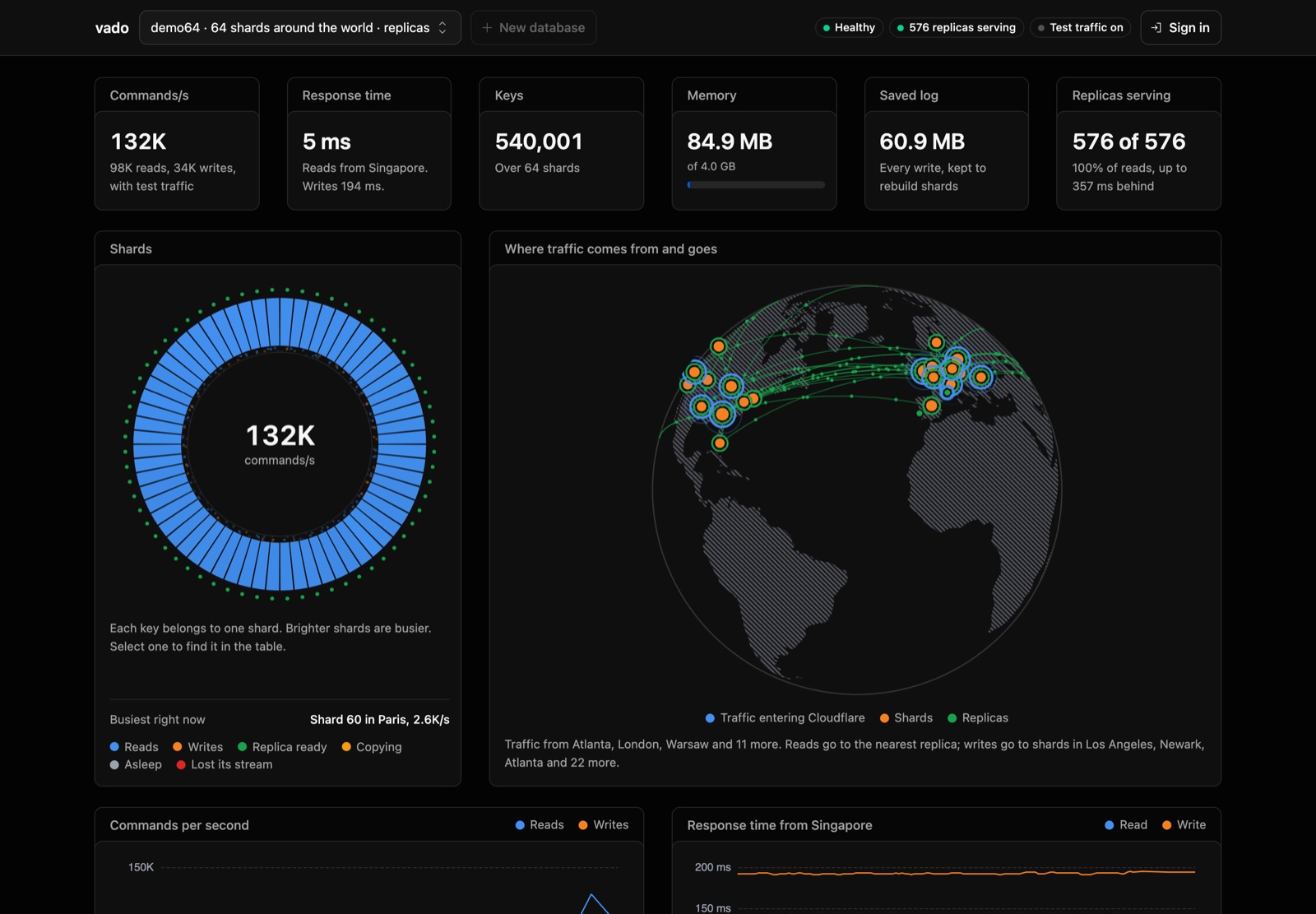
The dashboard watching a 64-shard database with a read replica of every shard in every region

A 64-shard database with a replica of every shard in every region.

Anyone can watch. People you let in through Cloudflare Access can also create databases, run commands, restart shards and start test traffic.

Read on

vado · Valkey and Redis on Durable Objects · Apache-2.0Independent and experimental. Not an official Cloudflare or Valkey product.

Browse topics or type to search

Introductionvado runs real Valkey 9.1, compiled to WebAssembly, in Cloudflare Durable Objects. A router in a Worker spreads keys over the shards, so valkey-cli and ioredis see one ordinary server.What you getIntroductionA first commandIntroductionThe dashboardIntroductionRead onIntroductionQuick startCreate the Access application, deploy the Worker, and connect valkey-cli or ioredis. About ten minutes on Workers Paid.1. Create the Access applicationQuick start2. DeployQuick start3. Connect valkey-cliQuick start4. Connect from a WorkerQuick startRun it locallyQuick startArchitectureA router per connection, shard objects running Valkey with their AOF in SQLite, and memory-only replicas in other regions. What each part owns, and what it costs.Where everything livesArchitectureHow clients reach itArchitectureRouterArchitectureShardsArchitectureRead replicasArchitectureRewritersArchitectureCatalogArchitectureWatcher, Pulse and the dashboardArchitectureWhat the design buys, and costsArchitectureSharding and routingKeys hash to 16,384 slots, slots map to shards in contiguous ranges, and a database's size and placement are fixed when it is created.Slots and shardsSharding and routingShard countSharding and routingPlacementSharding and routingHow the router routesSharding and routingCROSSSLOTSharding and routingShard classesSharding and routingConnectionsSharding and routingUnsupported commandsSharding and routingDurabilityEvery acknowledged write is in SQLite before its reply leaves. Group commit keeps that cheap under load, a helper object compacts the AOF, and deploys restart shards without failing commands.Write-through storageDurabilityGroup commitDurabilityAOF rewrites in a helperDurabilityWhen a shard resetsDurabilityClean restarts on deployDurabilityRead replicasEach shard can keep a memory-only copy in other regions, fed from its AOF. Routers read the nearest one, a connection always reads its own writes, and an idle database's replicas sleep.RegionsRead replicasCopy, then streamRead replicasWhat a replica read can seeRead replicasFailuresRead replicasIdle sleepRead replicasLife of a requestWhat happens between a client sending SET k v and reading +OK, and what each reply tells you.One SET, step by stepLife of a requestWhat a reply tells youLife of a requestOperationsDeploy, configure, create databases with a placement, sign in to the dashboard, drive the bench API, and upgrade without breaking running shards.DeployOperationsSettingsOperationsCreate a database with a placementOperationsDashboard sign-inOperationsThe bench APIOperationsUpgrading safelyOperationsSecurityWho can connect, what clients may change, how data travels, where copies live, and what the bench token and the dashboard allow.AuthenticationSecurityWithout a passwordSecurityWhat clients can changeSecurityTransportSecurityReplicas and data locationSecurityThe bench token and the dashboardSecurityLimits and measurementsWhat one shard holds, how fast writes and reads went, and the conditions behind each number. Measured on production in November 2026, on one account.LimitsLimits and measurementsMemoryLimits and measurementsThroughputLimits and measurementsLatencyLimits and measurementsReplicasLimits and measurementsRewritesLimits and measurementsCold starts and deploysLimits and measurementsFailure testsLimits and measurementsWhat these don't showLimits and measurementsRedisA database can run Redis 8.12 instead of Valkey. It is opt-in at build time because it doubles the upload and is distributed under the AGPLv3.Choosing RedisRedisBuilding with RedisRedisDifferencesRedisThe AGPL licenceRedisRepositoryAn npm workspace: two apps and three packages. How to check, test and build it, and what CI runs on every push.LayoutRepositoryCommandsRepositoryEnd-to-end testsRepositoryContinuous integrationRepositoryThe wasm buildsRepositoryCode rulesRepository
Local search. Nothing is sent to a server.Esc to close
Documentation